Food service has always had one simple promise: the meal should reach the customer in the condition it was meant to be enjoyed. A hot lunch should still feel like lunch, not a lukewarm compromise. A carefully packed order should not sit on a crowded counter where five people have to ask, "Is this mine?"
Restaurants, office cafeterias, hospitals, campuses, airports, and factories all face a similar problem. The kitchen may be efficient and the ordering system may work well. But once meals are packed, they often enter a messy middle stage: waiting, searching, checking receipts, and handing bags across a counter during the busiest minutes of the day.
This is where smarter pickup systems are starting to change the way food businesses think about service.
In food operations, the last few feet matter more than they appear. A meal can be prepared on time, but if the customer, rider, or employee cannot collect it quickly, the experience still suffers.
During lunch rush, pickup shelves can become crowded. Bags may be moved around. Staff have to stop what they are doing to answer questions. Delivery riders wait in the same space as dine-in guests. In secure buildings, schools, and office parks, access control can make the pickup process even slower.
For a single order, this is only a minor inconvenience. At scale, it becomes a real operational cost. Research published in the Journal of Operations Management, based on 94,404 restaurant customer visits over 12 months, found that longer waiting times were associated with more customers leaving before service, longer gaps before customers returned, and shorter dining durations.
The problem is not just speed. It is consistency. Businesses need a way to keep meals organized, protect the pickup process, and reduce unnecessary contact without turning every handoff into a manual task.
Contactless food pickup became widely discussed during the pandemic, but its usefulness goes well beyond health concerns. It gives food service operators a cleaner, more predictable process.
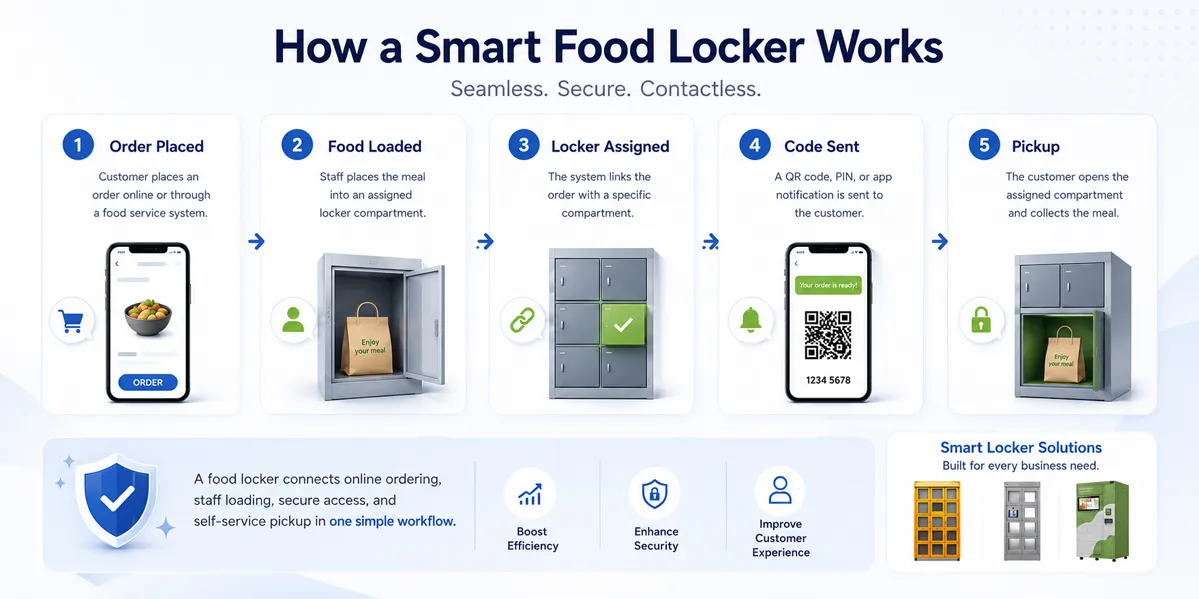
A well-designed pickup system separates the kitchen workflow from the customer collection point. Staff can load meals into assigned compartments. Customers or riders can retrieve the correct order through a code, QR scan, or digital instruction. The result is less confusion at the counter and fewer interruptions for the team preparing food.
For high-traffic environments, this matters. A hospital cafeteria may need to serve staff whose break times are short. A university dining provider may handle waves of students between classes. A factory canteen may need to support shift workers outside normal meal hours.
That is the practical value of a modern food locker system. It is not just a cabinet. It is a controlled pickup point that helps food move from preparation to collection with fewer bottlenecks.
Food pickup is different from parcel pickup because meals are time-sensitive. Hot food needs heat management. Fresh food may need refrigeration. Some ready-to-eat meals need to stay cold until they are heated.
This is why temperature control has become such an important part of unattended food service. Refrigerated storage can help keep prepared meals fresh before purchase, while integrated heating can make hot meals available even when a kitchen is not operating in real time. For customers, the question is simple: "Was the meal ready, easy to collect, and still good to eat?"
Not every food pickup cabinet is built for the same type of business. A small cafe has different needs from a hospital, and an airport has different traffic patterns from an office pantry. Before investing in a system, operators should look at a few practical details.
First, the compartment design should match the food format. Boxed meals, pizza, rice dishes, pies, and other packaged foods all need different storage considerations. A system with flexible compartment planning is easier to adapt as the menu changes.
Second, the pickup process should be clear. If customers need staff help to understand the machine, the system is not reducing workload. Touchscreen ordering, digital payment, pickup codes, and simple instructions can make a major difference.
Third, remote management and maintenance should not be an afterthought. Operators should be able to check inventory, monitor device status, adjust temperature or heating settings, and receive fault alerts without standing next to the machine.
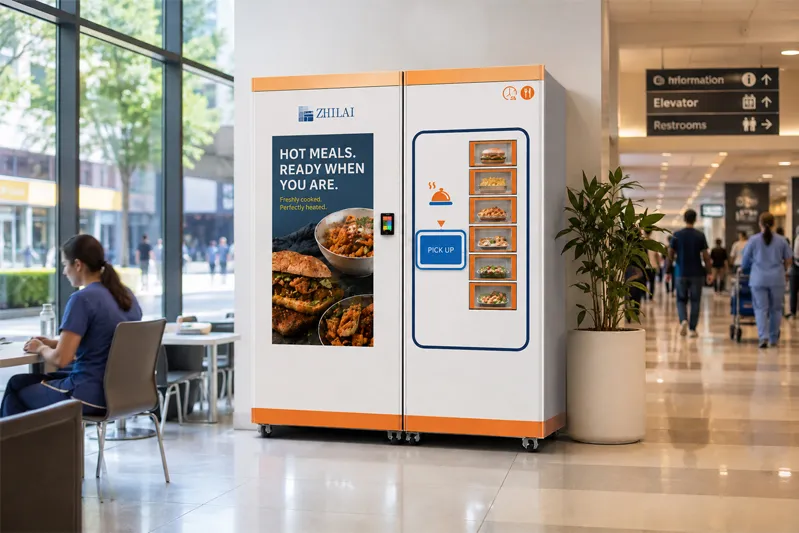
The best use cases are often places where people need reliable meals but cannot always wait in line. In office buildings, a smart pickup point can support pre-ordered lunches and after-hours meals. In schools, hospitals, airports, and transport hubs, it can reduce crowding and keep meal collection moving when staffed counters are busy.
The same idea also works for restaurants and delivery brands. A food locker can reduce handoff pressure, keep orders organized, and create a more professional pickup area for couriers and customers.
Shenzhen Zhilai Sci. and Tech. Co., Ltd., a company focused on intelligent storage and delivery. Founded in 1999, Zhilai has built smart locker and self-service delivery solutions for commercial environments across more than 50 countries and regions. Visit https://www.smartelocker.com/ to learn more about its product lines.
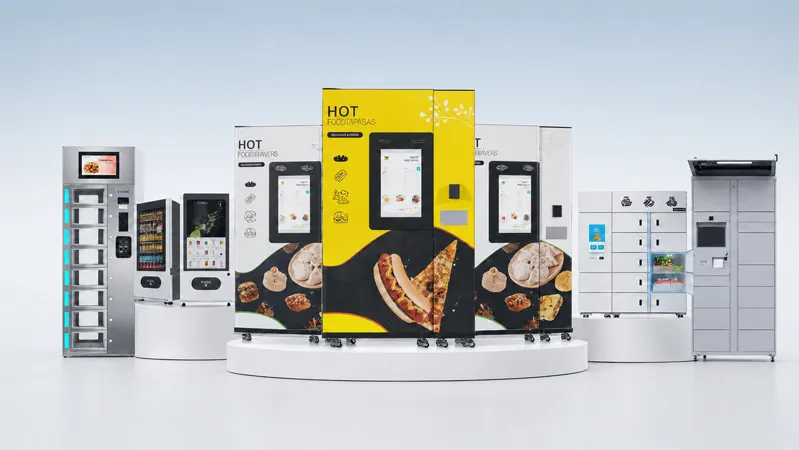
Across its hot food vending and food pickup solutions, Zhilai designs around real operating conditions: refrigerated storage, instant microwave heating, cloud-based management, self-service payment, contactless pickup, and traceability options such as QR codes for meal information. Some hot meal vending models are designed to heat meals in about 2.5 minutes, helping businesses extend hot food availability without relying only on staffed counters.
For business owners, the value is not in adding another machine for the sake of automation. The value is in making food service easier to manage, easier to scale, and easier for customers to trust.
Good food service does not end when the meal leaves the kitchen. It ends when the customer collects the right order, at the right time, in the right condition.
That final step is becoming more important as businesses serve more people across longer hours and more complex locations. Smart pickup systems help close the gap between preparation and collection. They reduce waiting, organize the handoff, and give operators better visibility over daily service.
In a world where convenience often decides whether a customer comes back, smarter food pickup is becoming part of how modern meal service works.